RICHARD O’SHAUGHNESSY
Research Homepage
RICHARD O’SHAUGHNESSY
Research Homepage
As a gravitational wave astrophysicist my research interest include compact objects and binary evolution. As a relativist, I investigate how to compute, describe, and measure the signal from generic precessing compact binaries in strong-field gravity.
The next few years' measurements will transform our understanding of binary stellar systems. Gravitational wave observatories like LIGO will detect gravitational waves from the mergers of two compact objects (neutron stars or black holes). Their rich gravitational wave emission will provide a wealth of information about each event. Space missions like GAIA will provide complementary information about close stellar systems throughout our own galaxy. Likewise, large-scale transient surveys are finding rare, previously-undiscovered signals. Some should be associated with rare epochs in stellar and binary evolution, like the common envelope phase. Others could be produced by the same violent physics of a compact binary merger itself, enabling a new era in multi messenger astrophysics.
Detecting and Interpreting Gravitational Waves
My principal research interest since 2011 has been developing and interpreting the gravitational wave signal from precessing black hole binaries. I believe these almost-generic sources will be the first events detected by gravitational wave detectors. Precession -- a slow change in the orbital plane, as all the coupled angular momenta evolve relative to one another -- produces distinctive amplitude and polarization modulations that encode otherwise-inaccessible information about those angular momenta. By breaking degeneracies between black hole spins and compact object masses, these measurements can allow strong constraints on remnant properties and hence on the processes that formed merging binaries: supernovae, stellar evolution, and stellar dynamics.
Gravitational Wave Astronomy: Gamma Ray Bursts and Binary Systems of Neutron Stars and Black Holes
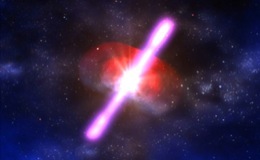
Gamma-ray bursts are the most energetic phenomena in the universe that we have directly observed. During their short lifetime they outshine in brightness their host galaxies many times over. The engine that powers these bursts is believed to involve the formation of a roughly stellar mass black hole, either from a hypernovae (the collapse of a massive star) or the coalescence of a binary system consisting of a neutron star and a black hole. In either case the black hole formation will also lead to a strong pulse of gravitational waves, which may be detectable with the next generation of ground-based gravitational wave detectors. From the gravitational wave burst associated with gamma-ray bursts we can learn about the black holes that have formed and the stars that led to their formation, which we cannot learn from the gamma-ray burst alone. My research is focused on what we can expect of the gravitational waves from binary systems of compact objects, like the progenitors of gamma- ray bursts, and what we can learn about these systems from gravitational wave observations either alone or in combination with observations made with more conventional detectors.
image credit Chandra X-Ray Center
Research Links
•Gravitational waves (from ligo.org)
•Background on gravitational waves and documentaries on gravitational wave astronomy
•Science summaries of LIGO papers
•For students and teachers:
Gravitational waves in the high-school classroom ; in higher education ; and as research experience for teachers, high school students, and undergraduates
•Gravitational wave astrophysics
•Summer schools: Caltech 2013; Amaldi 2013
•Conferences: GWPAW 2011, 2012; KITP 2013